


The Herbal Nomad Journey: From the Swiss Alps to the Provence:
Updated: Sep 3
There's a particular kind of quiet that settles over you when you've been on the road for weeks. My campervan is packed with essential oils and farm-fresh memories. I watch the landscape shift from snow-capped peaks to lavender fields to sun-baked orchards. That's where I find myself right now — somewhere between gratitude and wonder, looking back at the journey so far.
This is the story of the Herbal Nomad chapter: crossing the Alps from Switzerland into Italy, through France, and into Spain. It’s a journey not just across borders, but across traditions — of land, of plants, and of the people who have devoted their lives to both. Central and Southern Europe holds a rich heritage of herbal knowledge, woven into the daily lives of its people for centuries. This post shares my experiences, discoveries, and practical tips for anyone interested in exploring Europe's herbal treasures.

Discovering Herbal Traditions in Southern Europe
Where It Began: Switzerland
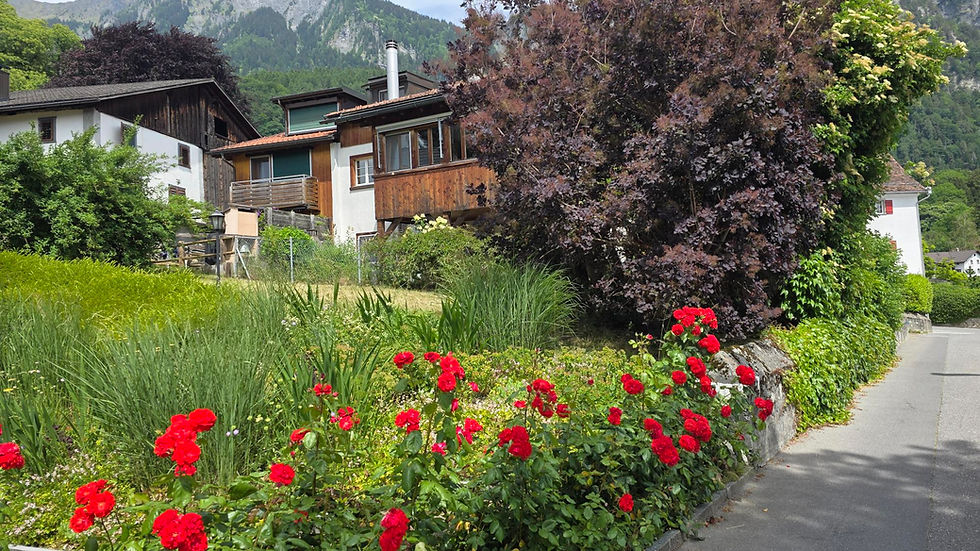
I grew up in the Swiss mountains. That relationship with botanicals — the fresh air, the scent of pine, and playing as kids in wildflower meadows — has shaped everything about how I connect with plants. When I started at my family's place in the Bündner Herrschaft in Graubünden, I was surrounded by roses in full bloom. Rose has long been considered the queen of botanicals. In natural skincare, it's deeply hydrating and gentle enough for even the most sensitive skin. In Aromatherapy, we call it a heart opener, and if you smell a rose, you know why. Rose Week wasn't just content for Sanflora Wellbeing; it was a homecoming.
Crossing Into Italy
From there, the campervan pointed south and east, toward the Alps themselves, and into wildflower country. Geraniums grow wild against alpine backdrops and in front of every farmer's house. It is such an underestimated plant, vibrant and beautiful, flowering all summer long. Its aroma oil is stored in its leaves. Just break one, and you will smell its green and rosy scent with a soft minty edge. Geranium is known for balancing skin and mood alike — a small, hardy flower with a surprisingly generous gift. It is one of my favourite essential oils to use in my natural skincare products.

Italy unfolded slowly — small farms, family-run vineyards, and vegetable plots tended with a kind of patience you don't see everywhere anymore. What struck me most wasn't any single ingredient, but the rhythm of it all. Meals built around what was harvested that morning. Wine made by people who could tell you the exact hillside their grapes came from. Herbs growing not in neat rows but wherever they'd decided to take root.
This is the heart of what Herbal Nomad means to me — not just researching plants, but absorbing the history and philosophy in daily life behind them. The idea that good things take the time they take.

Provence in France: The Heart of This Journey
If I had to choose one place from this journey that changed me a little, it would be Provence.
I arrived expecting lavender — and I got it, in fields so vast and so purple they looked unreal. But what I found went much deeper than a postcard image. I spent my days walking through working farms, not tourist attractions: places where lavender, rosemary, clary sage, and helichrysum (the everlasting flower) are grown, harvested, and distilled by people who have often inherited this work from their parents and grandparents.
Lavender was where it started — that unmistakable scent, calming and familiar, but somehow more alive standing in the field than it ever is in a bottle.

Rosemary came next, wild and resilient, growing on sun-baked hillsides with barely any water. There's something about rosemary's toughness that I find genuinely inspiring — it thrives on neglect and still gives so generously.
Clary sage surprised me. Its scent is complex, almost wine-like, and traditionally it's been used for its calming, balancing properties — something women in particular have turned to for generations.

And then there was helichrysum — the everlasting flower. The French call it Immortelle, and once you understand why, the name makes perfect sense. Even dried, the flowers never lose their golden colour. They stay vivid, bright, and unchanged. I stood in a helichrysum field and thought about how rare that is — for anything to remain so steadily, stubbornly itself. Je conserve la vie — I preserve life. That phrase followed me through the rest of the trip.
At La Ferme Bio de Vauvenières, I met growers who walked me through their distillation process from start to finish — harvesting, steam distillation, and the careful collection of the oil itself. I bought directly from them: organic, small-batch, traceable to the exact field I'd stood in. Those oils are now packed carefully in my campervan, on their way back to New Zealand.

A Dive into Aroma Therapy
As an Aroma Therapist and Natural Skincare Formulator, spending this much time among distillers and growers has meant the world to me. Diving properly into the daily life of Aromatherapy — not as a theory, but as a living, breathing tradition — was just wonderful.
Aromatherapy, at its core, is the practice of using the aromatic compounds within plants — essential oils — to support physical, emotional, and mental wellbeing. It's not new. It draws on centuries of traditional knowledge from cultures all over the world, refined over generations through observation, experience, and care. What I've witnessed in Provence is that this tradition is still very much alive. The distillers I met aren't relics of the past — they're working farmers and chemists, blending old knowledge with real craft, producing oils of extraordinary quality.
What makes Aromatherapy so beautiful is how naturally it integrates into everyday wellbeing — what I think of as "scented wellbeing." The compounds found in these plant extracts are tiny molecules, and they're not new discoveries — they've been used in herbal medicine for thousands of years, long before anyone could explain why they worked. We now understand a little more of the science: these molecules are small enough to enter our body through the skin or through our olfactory nerves when we simply breathe them in. From there, they send messages through the body — calming, stimulating, balancing, healing. It's a beautifully direct form of communication between plant and person.
And the quality of that communication depends entirely on the quality of the plant. The oils I sourced in Provence carry the strength of the Provençal sun and the character of the soil they grew in — concentrated, over a whole season, into something extraordinarily small and extraordinarily potent. That's the difference between a mass-produced extract and a true, organic, small-batch essential oil. You can feel it. When lavender calms you and also softens your skin, when rosemary stimulates circulation and smells like sunshine on a hillside, when helichrysum repairs skin and lifts your mood like warmth itself — that's not coincidence. That's the plant, doing what it's always done.
This is exactly the philosophy I've built Sanflora Wellbeing around, long before this trip. But standing in these fields, meeting these makers, has deepened that belief in a way I didn't expect. Scented wellbeing isn't a marketing concept. It's something real, something earned, something rooted quite literally in soil.

A Word for My Sanflora Friends
If you've been following along through Instagram and Facebook — through the lavender fields, the rosemary hillsides, the clary sage, and the everlasting — thank you. Genuinely. Sharing this journey with you has made it feel like we're discovering all of this together.
This is why I do what I do. Sanflora has always been about nature connection. "Nurture nature. Nature nurtures us." isn't just a tagline for me; it's how I was raised and how I've tried to build this brand from the very beginning. Travelling like this, meeting the people behind the plants, and watching traditional knowledge passed down and still practiced — it reconnects me to why Sanflora exists in the first place.
Bringing It Home
There's one more chapter still to come — the orange fields of Catalonia. The journey continues, and I can't wait to share it with you on Facebook or Instagram.
But for now, I'm thinking about what's already packed away in the van: organic lavender, rosemary, clary sage, and helichrysum oils, sourced directly from the people who grow and distill them. Soon, these will make their way into new Sanflora products, carrying with them not just their botanical properties, but the story of the fields they came from and the hands that harvested them.
And while I'm out here on the road, the full Sanflora range remains available online — handcrafted in Queenstown, made with the same honesty and care I've found in every farm I've visited on this journey.
Thank you for being part of this with me.
— Sandy
Sanflora Wellbeing | The Herbal Nomad


Comments